


FFG Forschung Textil-RE-acts

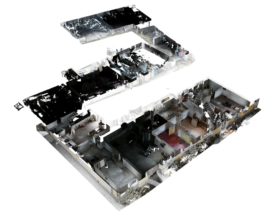
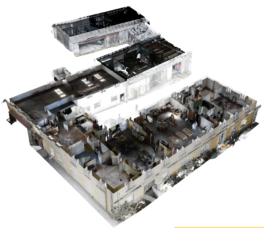
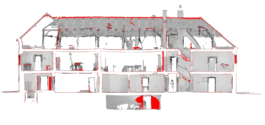
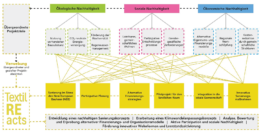
Rethink, Reuse and Renovate - dieTextilfabrik als Reallabor für Revitalisierung und Resilienz nach den NEB-Prinzipien (New European Bauhaus). Unter diesem Langtitel entsteht ein zukunftsweisendes Reallabor für gemeinschaftliches Wohnen, kulturelle Teilhabe und nachhaltige Bestandsentwicklung. Die leerstehende ehemalige Strickwarenfabrik aus dem Jahr 1850 soll denkmalgerecht saniert und in einen gemeinschaftlich getragenen Lebens-und Kulturort überführt werden – als sozial, ökologisch und wirtschaftlich tragfähige Alternative zum Einfamilienhaus-Neubau im ländlichen Raum, ganz ohne zusätzlichen Bodenverbrauch.
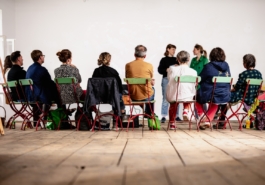
Herzstück des Projekts ist eine partizipative Baugruppe, deren Formierung im Rahmen eines parallellaufenden Forschungsprojekts der Niederösterreichischen Wohnbauforschung begleitet wird. Von Beginn an wird diese an allen zentralen Entscheidungsprozessen beteiligt, von der Sanierungskonzeption bis hin zur zukünftigen Nutzung und Organisation. Gemeinsam mit lokalen Akteur:innen – etwa Handwerksbetrieben mit Potenzial zur Abwärmenutzung und der Gemeinde – werden innovative Finanzierungs- und Eigentumsmodelle (z. B. HabiTAT oder Mietshäusersyndikat) auf ihre langfristige soziale und wirtschaftliche Tragfähigkeit geprüft.
Die Sanierung folgt den Prinzipien des New European Bauhaus (NEB): Nachhaltigkeit, Ästhetik und Inklusion. Im Zentrum steht ein ressourcenschonender und zugleich identitätswahrender Umgang mit dem historischen Bestand: Der Einsatz ökologischer Baustoffe, CO₂-neutraler Energielösungen und klimaresilienter grün-blauer Infrastrukturverbindet technische Innovation mit baukultureller Verantwortung.
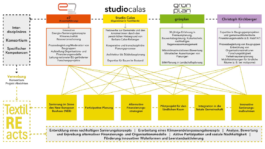
In Zusammenarbeit mit E7 energy innovation & Engineering GmbH (Project Lead), grünplan Landschaftsarchitekten, Christoph Kirchberger (Experte für alternative Finanzierungs- und Organisationsformen).
Rethink, Reuse and Renovate – dieTextilfabrik as a real-world laboratory for revitalization and resilience based on the principles of the New European Bauhaus (NEB). Under this comprehensive title, a forward-looking real-world laboratory for collective living, cultural participation, and sustainable redevelopment of existing buildings is being created. The vacant former knitwear factory dating from 1850 is to be renovated in accordance with heritage conservation standards and transformed into a collectively supported place for living and culture as a socially, ecologically, and economically viable alternative to new single-family housing developments in rural areas, without any additional land consumption.
At the heart of the project is a participatory building group, whose formation is accompanied by a parallel research project funded by the Lower Austrian housing research program. From the very beginning, the group is involved in all key decision-making processes, from the renovation concept to future use and organization. Together with local stakeholders, such as craft businesses with potential for waste-heat utilization and the municipality—innovative financing and ownership models (e.g. HabiTAT or the Mietshäusersyndikat) are being examined for their long-term social and economic viability.
The renovation follows the principles of the New European Bauhaus (NEB): sustainability, aesthetics, and inclusion. Central to the project is a resource-efficient yet identity-preserving approach to the historic building fabric. The use of ecological building materials, CO₂-neutral energy solutions, and climate-resilient green-blue infrastructure combines technical innovation with responsibility for the built cultural heritage.
In collaboration with E7 energy innovation & engineering GmbH (project lead), grünplan Landschaftsarchitekten, and Christoph Kirchberger (expert in alternative financing and organizational models).
Year:
2025 -
Location:
Hirschbach/AUT
Client:
Österreichische Forschungsförderungsgesellschaft mbH (FFG)